
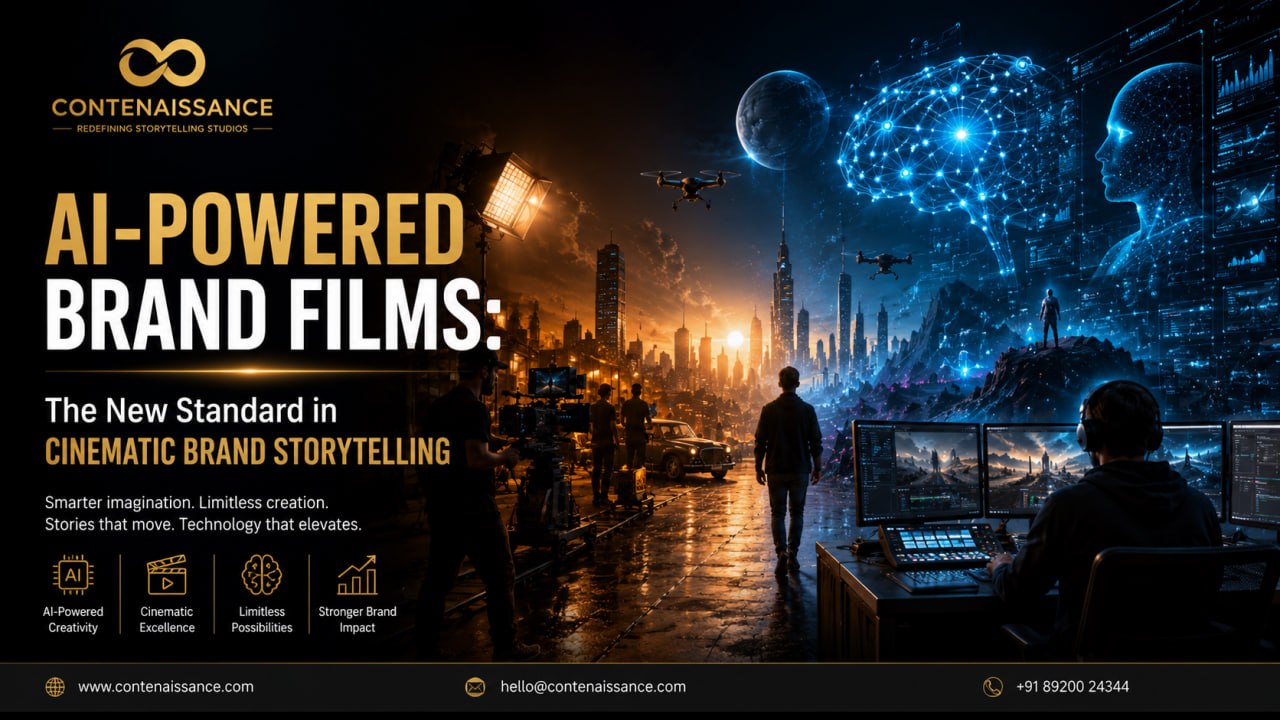
Several years ago, "brand film" would have meant finding the right filming locations, renting out a complete set of camera equipment, hiring fifteen people, and spending enough money that only a few corporations could justify doing it. This math has now changed, and thanks to AI-powered brand films, a medium-sized corporation can now create the same visual and emotive effect in much less time and at significantly lower costs.
It is not just about technology; there really has been a paradigm shift in the way a brand story gets told on film.
What is an AI-Powered Brand Film?
An AI-Powered brand film is a short-form video, made up of cinematographic visuals generated through AI technology, whether in terms of environments, visuals, motion graphics, and even voice, combined with live action footage or complete synthetic scenes that represent a brand’s narrative, mission, and identity.
This differs from a conventional commercial, which aims to sell a product or service; instead, a brand film sells an emotion. This video aims to respond to the following questions: Who is this brand? What world do they belong to? Why should I trust them? AI technology simply provides the film makers with new tools that help them respond to such questions using visual imagery that is not possible within the budget of most productions.
Within Contenaissance, it generally entails combining footage of a brand, their employees or products with 3D environments and motion graphics.
How AI Brand Films Differ From Traditional Video Production
The traditional film requires numerous physical limitations that must be taken into account: location availability, weather conditions, number of participants, rental costs of equipment, and a lengthy post-production process that can take several weeks. Each idea that you have has its price, but this is the exact reason why all brand stories tend to look alike – with the same stock location, the same lighting arrangements, and the same three-act structure.
AI-driven production gets rid of some of the mentioned limitations. First, the synthetic environment doesn't require any weather permit. Second, generative backgrounds don't need any location fee. Finally, iterations of a scene don't require shooting it once again – they require regeneration. This is how creative people can come up with more ideas, move beyond realistic images, and meet deadlines that cannot be achieved with traditional filming.
However, it doesn't mean that the camera goes away. The majority of successful AI brands still have real actors, real products, and real environments that provide the emotional base for the film, and then create an extension or enhancement of those images using the power of artificial intelligence.
Why Should Brands Invest in AI-Powered Brand Films Right Now
There are a few factors that are driving brands in the direction of this specific format simultaneously.
The cost of attracting attention is higher than ever. Feed is oversaturated, and users scroll past anything that seems ordinary in just a couple of seconds. Visual difference makes a brand film unique and therefore gives an opportunity for a longer look.
Brands do not have enough resources for production. It becomes increasingly difficult to keep up with marketing demands as more videos are needed to be produced in different formats. Artificial intelligence allows creating a cinematic film using minimalistic resources.
Speed of development plays a vital role. Every product launch, rebranding or season campaign requires a specific schedule. The production process takes weeks, if not months, with traditional visual effects and location shooting. Using AI speeds up the whole process.
The audience prefers novelty. A synthetically created world, unusual transitions, or an entirely new visual style will stand out precisely because of that novelty. A brand film, created using AI, provides more opportunities for being experimental with visuals than conventional filming.
What Goes Into Producing an AI-Powered Brand Film
An ideal AI brand films is not simply a prompt put into a video generator program. Rather, it is a production process, which takes place using another set of tools. In the case of Contenaissance, here is how this process usually goes:
Story comes first. The strategy behind the film and its key message have to be created first, before any visual elements appear. This includes defining the emotions that the brand wants its audience to experience after watching the film and in what environment the film will be watched (it's quite a different thing whether it is a 90-second video for a hero section on the company's website or a 15-second cut for the reel).
Live-action filming, where it helps tell a story better. Real people, objects, or spaces cannot be substituted for a completely synthetic visualization.
AI-driven creation of 3D environments and motion design. This is the point when the “AI-powered” part shows itself in its true nature – synthetically generated sets, camera moves, worlds and visual effects that would normally take a full-fledged VFX pipeline and time to create.
Music, voice over and sound effects. Sound elements are actually what makes a brand film cinematic instead of being a highlight reel. This process does not change dramatically with AI, but remains no less important.
Editing and platform-specific versions. Normally, one brand film requires editing into several versions for the website, social networks, paid media etc., so that the story reaches all the right audiences.
Top Industries Reaping Big Benefits from AI Filmmaking for Brands
Although all brands can derive significant benefits, there are certain industries that derive the biggest advantage:
Real estate and infrastructure – thanks to virtual environments, which allow you to show a building or master plan long before it is constructed.
D2C and product brands, because they require frequent video creation on social media without having to reshoot everything every single time.
Corporate and B2B brands, by telling stories through film to make an industry that can be quite boring – such as manufacturing or agricultural machinery – more human.
Key Things to Consider When Partnering with a Brand Film Maker for AI
Just because someone says that they use AI does not mean that they have a craft-first methodology. Here are some key things to check before choosing a partner:
Portfolio and not promises. Ask to see the final products of their brand films rather than single clips made by AI.
Blended workflow. The best projects tend to combine real-life footage and AI-generated elements as only AI-made videos may start looking too artificial.
Strategy first, visuals second. If a company starts creating visuals immediately and does not ask any questions regarding the strategy of the brand, then there will be no sense in their work.
Platform-first approach. It means that a brand film should work as a hero video of 90 seconds and 15-second reel.
Where Contenaissance Comes Into the Picture
Contenaissance creates AI-driven brand films through a combination of generative AI, 3D technology, and storytelling artistry, with the aim of crafting a cinematic experience which just happens to be "AI-driven". No matter if we talk about commercials, social media content, or complete documentaries on brands, the rule stays the same: AI is only a means to an end, and the end is a good story.
In case your brand is ready to go beyond general and stereotypical stock video footage, and to dive into something more personalized and customized for 2026 content consumers, that's the discussion worth conducting.
FAQs
Is an AI brand film completely computer-generated?
Most AI brand films will contain a mix of real elements (people, objects, and locations) combined with AI generated backgrounds, motion graphics, and other visual effects. It is possible to create fully computer-generated AI films, but it is unlikely to build trust in such films.
How does the cost of an AI brand film compare with a regular brand film?
It depends, but it is lower due to decreased costs related to shooting on location, small crews, and VFX rendering. It depends on the length and the complexity of the project.
How long does it take to make an AI brand film?
Shorter timelines than those of a full-fledged traditional brand film due to lower dependence on physical filming and location shoots. But it still takes some time to get things right.
Does video production based on AI only concern large companies?
No – this is one of the key differences here. Due to the reduction in traditional costs associated with video production, mid-size and growth companies can now create videos at the level which was exclusive to the largest companies.
