
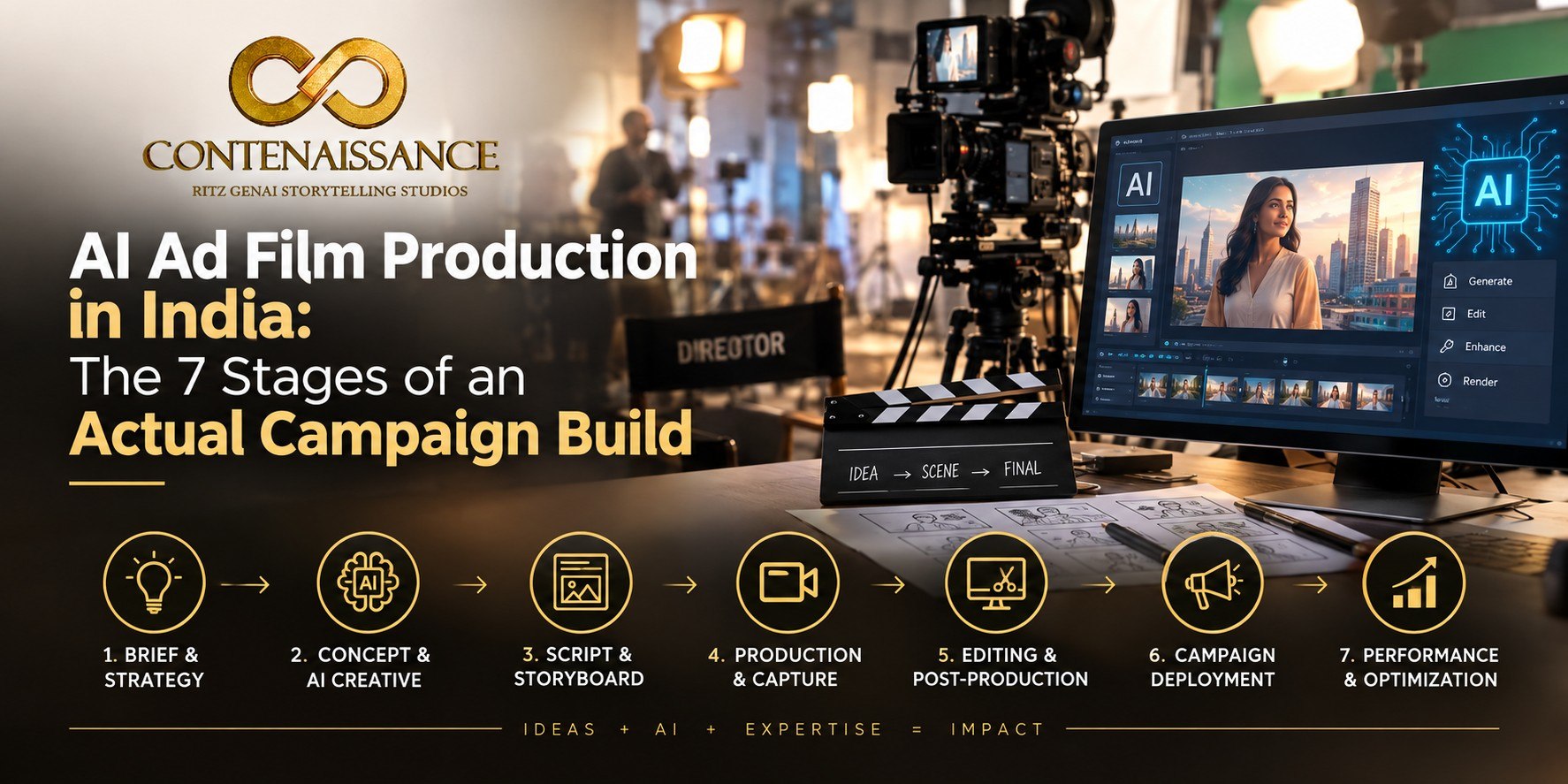
AI Ad Film Production in India: The 7 Stages of an Actual Campaign Build
AI ad film production in India runs on a seven-stage pipeline: brief lock, script and visual territory, previsualisation, consistency setup, generation and human finishing, compliance and labelling, then versioning for delivery. Most of the calendar and most of the risk sit in stages one to four, before a single finished frame exists. That is the part almost nobody writes about publicly.
Search this topic and you will find rate cards and turnaround promises. Useful for a budget conversation, much less useful on the Monday your campaign actually starts. Here is the process itself, with the specific inputs your team has to hand over at each stage, because those inputs decide the outcome at least as much as the tools do.
Stage 1: Lock the brief before anyone opens a tool
The first stage has nothing to do with AI. It fixes the product truth, the claim you are allowed to make, the audience, and the channels the film will actually run on.
Channel matters more than most briefs admit. A 30-second YouTube pre-roll, a six-second bumper and a vertical Reel are not the same film cropped three ways, and deciding that at the end is how budgets quietly double.
What your team supplies: product facts and any claims already cleared by legal, brand guidelines, existing logo and packaging files, the media plan, and one named approver. One approver, not a committee that assembles at stage five.
Stage 2: Script and visual territory, usually three at once
Traditional production forces an early commitment to a single script because exploring three means paying for three. Generative workflows remove that constraint, which is the genuine creative advantage rather than the cost saving everyone leads with.
A competent AI ad film studio will bring you two or three distinct visual territories against the same brief: a documentary-realist treatment, a stylised 3D treatment, a product-hero treatment. You pick a direction with evidence in front of you instead of from a paragraph of description.
What your team supplies: a decision, within the window agreed at stage one.
Stage 3: Previsualisation, the approval gate that protects the budget
Previsualisation is where mood boards, storyboards and 3D previews show you the film before it is built. This stage exists to catch the expensive disagreements early, when changing direction costs a day rather than a fortnight.
It is also the stage that separates studios. Contenaissance was set up around exactly this capability, producing on-brand copy, visual concepts and 3D previews in hours rather than weeks so that scripts, hooks and visual territories can be tested in parallel. The same AI brand films pipeline that produces the finished cinematic piece also produces the preview you sign off on.
What your team supplies: written approval of one territory, plus any internal stakeholder objections surfaced now rather than later.
Stage 4: Consistency setup, the stage that separates a film from a showreel
Generating one striking shot is straightforward in 2026. Holding the same product, the same face, the same environment and the same lighting across a hero film plus six reel cuts and three static variants is the real technical work, and it is the stage most DIY attempts collapse at.
This is where a studio locks reference assets: product geometry, brand colour values, character references, environment plates. Skip it and you get twelve beautiful shots that clearly belong to twelve different films.
What your team supplies: high-resolution product assets, 3D or CAD files where they exist, accurate colour references, and packaging that reflects what is currently on shelf.
Stage 5: Generation and the human finishing pass
Only now does generation begin, followed by the pass that decides whether the film reads as premium or as synthetic: editing rhythm, colour grade, sound design, voice, and music.
Nobody in this category ships raw model output. The consistent line across professional studios in India is that AI compresses production while human creative direction still carries story, cultural nuance and brand accuracy. Judge a studio on this pass, not on its generation samples, and ask to see the work before and after it.
What your team supplies: feedback in one consolidated round with timecodes, rather than three separate email threads.
Stage 6: Compliance, disclosure and the ASCI labelling question
This is the stage almost no article on AI ad film production in India mentions, and the one your legal team will ask about first.
ASCI released draft guidelines for responsible labelling of synthetically generated content in advertising in May 2026, open for consultation until 13 June 2026. The framework is risk-based and focuses on consumer outcomes rather than on the technology, sorting AI-generated advertising into high risk where content is prohibited, medium risk where labelling is mandatory, and low risk where no label is needed. Medium-risk examples include synthetic influencers or ambassadors, replicating a real person's likeness or voice even with their consent, AI-generated visuals of product performance that do not reflect how the product actually performs, entirely AI-created realistic events or settings, and demonstrations of products that do not yet exist. Routine enhancements such as colour correction, background visuals, ambient music and fantastical effects fall in the low-risk bucket.
For a real estate developer visualising a project that is not built yet, or an FMCG brand generating a product demonstration, that is a live labelling question rather than a theoretical one. Suggested labels include wording along the lines of audio or video created using AI, or enhanced using AI. The guidelines were still at draft stage at the time of writing, so confirm the current position with ASCI or industry coverage such as exchange4media before your campaign goes live. MediaNews4U
What your team supplies: legal sign-off on claims, and documented consent for any real person whose likeness or voice appears.
Stage 7: Versioning, languages and delivery specs
The final stage is where AI-led production pays back hardest. Once the look is locked, additional cuts, aspect ratios and language versions are variations on an existing build rather than new productions.
Plan for it explicitly:
- Aspect ratios per platform, not one master cropped after the fact
- Language versions with correct lip sync or a considered voiceover approach
- Regional or city-specific variants where the media plan calls for them
- Static key visuals pulled from the same visual system, so your visual identity systems hold together across film, social and web
What your team supplies: the final list of deliverables and specs, ideally confirmed back at stage one.
Where AI ad film production still loses to a camera
Three situations still favour a traditional shoot, and any studio that tells you otherwise is selling rather than advising.
- Sustained human emotion in close-up. Long held performance on a face remains the hardest thing to fake convincingly.
- Celebrity and ambassador work. Consent, contracts and disclosure obligations make this more complicated with AI, not less.
- Literal product demonstrations under regulatory scrutiny. If the visual has to prove exactly how the product performs, film the product.
The practical answer for most Indian brands is a hybrid: real product footage extended with AI environments, or a live-action hero cut with AI-generated variants around it. That mix keeps the authenticity where it matters and the speed everywhere else.
Questions marketing teams ask before stage one
How long does AI ad film production in India actually take?
Days to a couple of weeks for most digital campaigns, against six to ten weeks for a conventional TVC. The variable is rarely the generation itself. It is how fast approvals move at stages one and three.
Is AI ad film production cheaper than a traditional shoot?
Usually yes, because crew, location, travel and reshoot costs largely disappear. Pricing still varies with length, complexity and the number of deliverables, so compare on scope rather than on a headline rate.
Do we have to label an AI ad film in India?
It depends on the risk tier under ASCI's draft framework. Minor enhancements do not require a label. Synthetic spokespeople, replicated likenesses and AI-generated product performance visuals do.
Can we use our existing brand assets?
Yes, and you should. Your logo files, 3D product models, packaging artwork and colour system all feed stage four directly and materially improve consistency.
Starting your own stage one
The brands getting real value from AI ad film production in India are not the ones with the best prompts. They are the ones who arrive at stage one with their product truth, their asset library and their approval chain already in order, then let the studio compress everything after that.
Contenaissance runs this pipeline end to end with a creative team behind the technology rather than in front of it, across brand films, digital-first content, AI-powered campaigns and identity systems, with work spanning real estate, infrastructure, FMCG and manufacturing brands. You can see the output of the process in our work, or read how the same approach applies to property launches in our piece on real estate creative work.
If you have a campaign with a date on it and you want to know which stages are realistic in the time you have, get in touch and we will map it against a real calendar.
