
Picture an ad where Shah Rukh Khan says your local shopkeeper's name out loud, or a Sachin Tendulkar who looks 24 again sells insurance to millions. Neither celebrity had to show up on set.
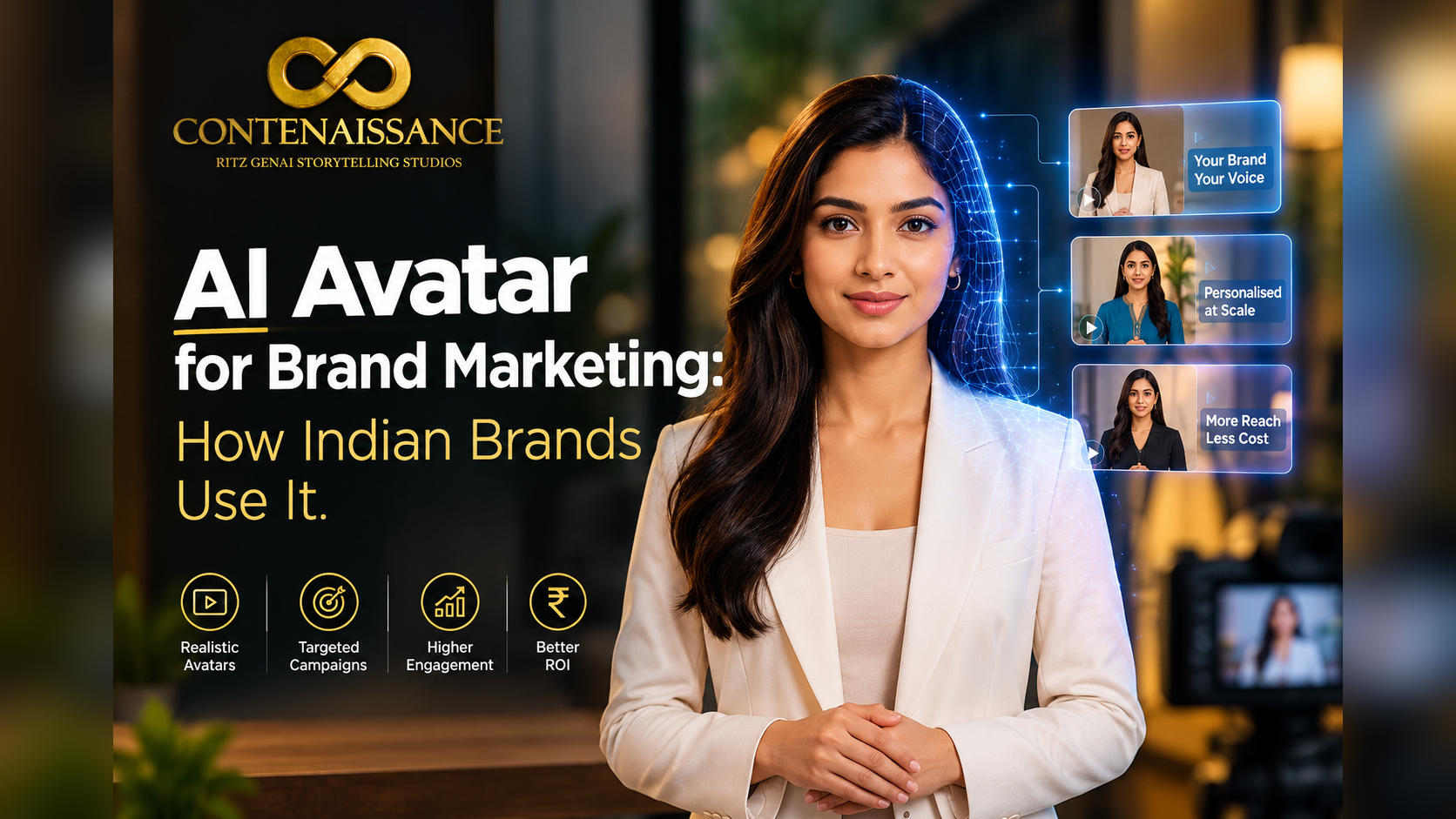
An AI avatar for brand marketing is a digitally generated face, voice and likeness, built with generative AI tools, used to deliver branded content at a scale no human shoot could match. Indian brands have run these campaigns since 2021. This piece looks at how an AI avatar for brand marketing works, which Indian brands have used one, where the format falls short, and what ASCI now requires. For wider context, see AI ad film production in India.
What is an AI avatar for brand marketing
An AI avatar for brand marketing is a synthetic version of a face and voice, generated or modified with AI, that delivers brand messaging in place of filming a person.
It can come from a real celebrity's licensed likeness, as with Cadbury's Shah Rukh Khan campaign, or from a fully invented character, like boAt's Kyra. Once the model is trained, the avatar can speak any script, in any language, in as many personalised versions as a brand needs. There's no shoot anymore, just a licensed face and a script, generated as often as the media plan calls for.
How an AI avatar for brand marketing actually works
Behind every AI avatar campaign sits roughly the same sequence, whether the face belongs to a cricketer or a CGI character built from nothing.
- A real person's face, voice and expressions get licensed under agreement, or a fictional avatar gets designed from scratch.
- The system learns facial movements, voice patterns and speech rhythm from reference footage.
- The same script gets regenerated thousands of times, swapping in a different name, city or language.
- Someone checks lip-sync accuracy and voice naturalness during render and quality-check.
- ASCI's rules require a label before the ad goes live.
How Indian brands are already using AI avatars
Indian brands have run AI avatar campaigns since 2021, and the list already includes some of the country's biggest advertisers.
Brand | AI avatar used | What it did |
|---|---|---|
Cadbury | Shah Rukh Khan AI avatar | Personalised ads naming local shopkeepers and stores |
Zomato | Hrithik Roshan AI avatar | Mother's Day campaign with personalised video messages |
Ageas Federal Life Insurance | Sachin Tendulkar AI avatar | Delivered policy explainers in a deepfake-style ad |
Pepsi India | Salman Khan's "Prem" character avatar | Revived a film character for a brand campaign |
boAt Lifestyle | Kyra (CGI avatar) | 2024 campaign built around creative storytelling |
Ikonz x Sourav Ganguly | Licensed cricketer AI avatar | Ads, fan events, virtual coaching appearances |
Cadbury built its campaign with Bangalore-based Rephrase.ai, alongside Ogilvy and Wavemaker, generating personalised videos of Shah Rukh Khan naming individual shopkeepers and reaching more than 85,000 retailers. Zomato took a similar route, putting Hrithik Roshan's face and voice onto Mother's Day messages naming locally famous food outlets.
Ageas went the de-aging route instead. Its CMO said the AI layer alone consumed more than half of a ₹70 lakh budget to make Sachin Tendulkar look decades younger, a different cost structure, not a cheap shortcut.
Why Indian brands are adopting AI avatars now
Brands are turning to an AI avatar for brand marketing because the format solves problems a human shoot cannot.
- One script becomes thousands of name-specific or store-specific variants, something no celebrity shoot schedule allows.
- The same avatar delivers a script in Hindi, Tamil, Bengali or English without booking the celebrity again.
- A campaign refresh takes a render cycle, not a new shoot date.
- The avatar has no film commitments or availability windows to work around.
- Once the model is trained, each additional version costs a fraction of an original shot.
None of this makes avatars free. The Ageas case shows the AI layer can still end up as the single most expensive line item on the budget.
Where AI avatars fall short, the trust gap
An AI avatar for brand marketing tends to fall short exactly when a brand most needs a customer to trust it.
What it cannot yet do is carry the weight a real human brings to a big-ticket decision, because viewers judge sincerity partly through the face delivering the message. Think of an insurance policy, a home loan, or a long-term health product. Consumers know the face on screen never actually used the product, and that gap matters more as the purchase gets bigger.
Avatars work well for retargeting, regional variants, product demos and FAQ-style content, where the job is clarity rather than persuasion. They work far less well at the top of the funnel, where a brand asks someone to believe in something for the first time. The format's real limitation isn't technical. It's psychological.
ASCI rules every Indian brand must follow
ASCI released its Guidelines for Responsible Labelling of Synthetically Generated Content in Advertising in September 2026. The framework sorts uses into three tiers by risk.
What a brand owes depends on what the AI avatar is doing:
- Prohibited outright: deepfakes, fabricated endorsements, or using a real person's likeness without consent. No disclosure label fixes a violation here.
- Mandatory disclosure: virtual or synthetic influencers, and any use replicating a real person's likeness for personalised messaging, must carry a visible label.
- Approved wording includes "Audio/Video created using AI" or "Audio/Video enhanced using AI." Labels the ad platform supplies also count.
- Paid endorsements by an AI avatar must state "Sponsored by [Brand]" explicitly.
One clarification matters more than the rest: a disclosure label does not fix an ad that's otherwise misleading or in breach of the ASCII Code. Labelling is a floor, not a shield.
Common mistakes brands make with AI avatar campaigns
Most missteps with an AI avatar for brand marketing happen because teams treat the format as a visual effect rather than a compliance and trust decision.
- Skipping the licensing agreement, assuming a "deepfake-style" effect is fine without documented consent.
- Forgetting disclosure, especially on performance ads that never get the scrutiny a hero campaign does.
- Using an avatar for a high-trust, high-value decision, which works against the credibility the ad needs.
- Treating the AI layer as the cheap option, then finding out, as Ageas did, that it can eat more than half the budget.
- Skipping quality control on lip-sync and voice, the fastest way to make an avatar look like a mistake rather than a choice.
AI avatar or human ambassador, a quick decision check
The choice between an AI avatar for brand marketing and a human ambassador comes down to the role the ad plays in the funnel, not just the budget.
Factor | AI avatar | Human ambassador |
|---|---|---|
Speed to produce variants | Fast, unlimited language and regional versions | Slower, needs fresh shoots or dubbing |
Cost at scale | Lower per-asset cost once set up | Recurring fees and usage-rights renewals |
Consumer trust at launch | Lower, especially for big-ticket decisions | Higher, aspiration and trust anchor the story |
Best-fit use | Retargeting, regional variants, FAQs, demos | Brand launches, emotional top-of-funnel storytelling |
Because an avatar rarely builds trust from zero, its strength lies elsewhere: helping a shopper who already knows the brand see the product more clearly, faster, at lower cost. A human face still does the heavier lifting when a brand asks someone to believe in something new.
FAQs
Is it legal for brands to use AI avatars of celebrities in India?
When the celebrity has given documented consent through a licensing agreement, the use is legal. ASCI's 2026 rules add one requirement: many of these uses need a visible AI label even when the licensing is legitimate.
Do AI avatars need to disclose they are AI-generated?
Disclosure is required for synthetic influencers, brand ambassadors and any personalised use of a real person's likeness. ASCI's risk-based framework makes it mandatory, down to approved wording like "Audio/Video created using AI."
What is the difference between a deepfake and a licensed AI avatar?
A deepfake uses someone's likeness without consent. A licensed AI avatar uses a real person's face and voice under a signed agreement. Most major Indian celebrity campaigns, including Cadbury's and Ageas's, take the licensed route.
Are AI avatar ads cheaper than celebrity shoots?
Not always. Once a model exists, extra variants get cheaper. But the initial AI and VFX build can still consume a large share of the budget, as Ageas's CMO confirmed.
Can an AI avatar replace a human brand ambassador entirely?
No, not for brand launches or high-value purchase decisions where trust must be built from scratch. Avatars perform best in supporting roles: retargeting, regional variants, demos and FAQ content.
Closing note
The Indian brands getting this right treat an AI avatar for brand marketing as one piece of a larger AI production approach, not a gimmick bolted onto an old campaign. Contenaissance works on AI-driven brand films and campaigns for clients including Eldeco Group, Fairfox IT Infra, Escorts Tractor, Saya Group and Madhusudhan Ghee. Anyone weighing an AI avatar against a traditional ambassador can Explore Now and put that question directly to the team.
